
Founded in 1995, Shakespeare Behind Bars is the oldest, continuously operating program of its kind in North America. Shakespeare Behind Bars has become a template for prison programs around the world.
Make not your thoughts your prisons.
—Caesar, Anthony and Cleopatra, V.2
The Mission of Shakespeare Behind Bars is to offer theatrical encounters with personal and social issues to incarcerated, post-incarcerated, marginalized, and at-risk communities, allowing them to develop and expand life skills that will support their reintegration into society.
We Know What We Are, But Not What We May Be.
—Ophelia, Hamlet, IV.5
The Vision of Shakespeare Behind Bars is inspired by the belief that all human beings are born inherently good. Although some convicted criminals have committed heinous crimes against other human beings, the inherent goodness is not negated by their criminal deeds. It can be called forth by immersing participants in the sanctuary of a Circle of Truth and its creative process.
What a piece of work is a man!
how Noble in Reason?
how infinite in faculty?
in form and moving how express and admirable?
in Action, how like an Angel?
in apprehension, how like a God?
the beauty of the world,
the Paragon of Animals;
and yet to me,
what is this Quintessence of Dust?
—Hamlet, II.2
The Philosophy of Shakespeare Behind Bars is that all citizens, incarcerated or not, have an authentic voice that is their strength. This voice can find renewed relationships to self and society through art, theatre (specifically, in our work, the collected works of William Shakespeare), and original writing.
There is a special providence in the fall of a sparrow.
If it be now,
’tis not to come;
if it be not to come,
it will be now;
if it be not now,
yet it will come –
the readiness is all.
—Hamlet, V.2
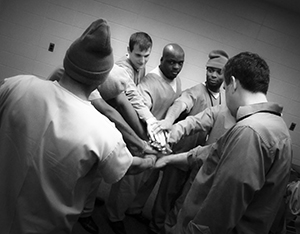
LEARNING OUTCOMES from building a Circle of Truth are allowing each participant the opportunity to 1) develop a lifelong passion for learning, especially those participants who are at high risk of not completing or continuing their education; 2) develop literacy skills (reading, writing, and oral communication), including those participants who identify or are classified as learning disabled and/or developmentally challenged; 3) develop decision making, problem solving, and creative thinking skills; 4) develop empathy, compassion, and trust; 5) nurture a desire to help others; 6) increase self esteem and develop a positive self image; 7) take responsibility for the crime/s committed; 8) become a responsible member of a group, community, and family; 9) develop tolerance and the skills for peaceful resolution of conflict; 10) relate the universal human themes alive in Shakespeare’s works to their own past, present, and future life experiences; 11) develop trust and the courage to act despite the fears and the odds stacked against them; 12) inspire and support a belief in hope, transformation, redemption, forgiveness, and the possibility of returning to society as a contributing member.
Be not afeard,
the isle is full of noises,
sounds,
and sweet aires,
that give delight
and hurt not.
Sometimes,
a thousand twangling instruments
will hum about mine ears,
and sometimes voices —
that if I then had waked after long sleep,
will make me sleep again —
and then,
in dreaming,
the clouds methought would open and show riches
ready to drop upon me,
that when I waked
I cried to dream again.
— Caliban, The Tempest III.2
Diversity, Equity, and Inclusion Statement
Shakespeare Behind Bars is an inclusive organization that proactively enlists intentional strategies to remove barriers to access, participation, and the success of those who were historically or are currently systematically excluded or marginalized.
Shakespeare Behind Bars values diversity and practices inclusion within its staff organization, program facilitators, teaching artists, program participants, and associates. For the continued advancement of the work of Shakespeare Behind Bars, we champion equal access and equity of opportunity through the intentional inclusion of all.
Shakespeare Behind Bars values diversity and inclusion across identity groups and professional levels. Identity groups include and are not limited to age, appearance, disability, ethnicity, gender (identity or expression), geographic location, nationality, professional level, race, religion, and sexual orientation.
Land Acknowledgement
Together we, at Shakespeare Behind Bars/Michigan acknowledge that we gather near the banks of Mishigamaa (Lake Michigan) on the traditional land of the Odawa (Ottawa), Ojibwe (Chippewa), and Nishnabek (Potowatami) Peoples, past and present;
at Shakespeare Behind Bars/Kentucky on the traditional land of the Cherokee, Chickasaw, Shawnee, and Yuchi Peoples, past and present;
at Shakespeare Behind Bars/Illinois on the traditional land of Sauk, Mesquakie, Potawatomi, Kickapoo, and Winnebago Peoples, past and present.
We honor with gratitude the land itself and the people who have stewarded the land throughout the generations. As a community, we recognize the ever-present systemic inequities that stem from past wrong-doings. We acknowledge this long history of injustice and commit to educating ourselves and our community as we seek to honor the legacy and culture of Indigenous Peoples.
Recidivism Rates
National average = 68%*
Kentucky = 27%**
Shakespeare Behind Bars = 6%
*National Institute of Justice.
**Kentucky Department of Corrections